

Crafting Tailored Satellite Payload Design Solutions
- May 11
- 4 min read
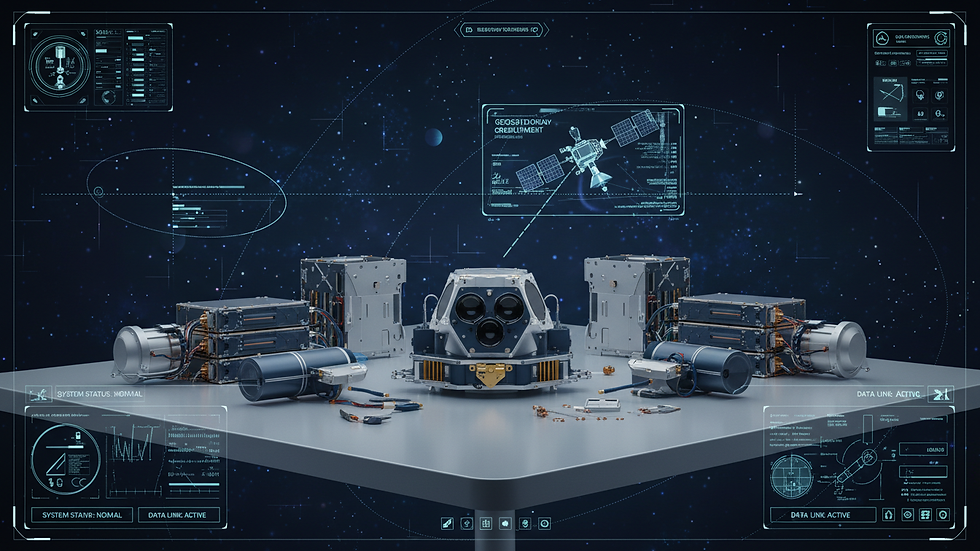
In the evolving landscape of space exploration and satellite technology, the design and integration of satellite payloads have become increasingly critical. The payload is the core of any satellite mission, defining its purpose and capabilities. Crafting tailored satellite payload design solutions requires a deep understanding of mission objectives, engineering constraints, and the operational environment. This article explores the technical considerations, design methodologies, and practical approaches to developing payloads that meet specific mission requirements with precision and reliability.
Understanding the Importance of Tailored Satellite Payload Design
Satellite payloads are specialized instruments or systems that perform the primary functions of a satellite, such as communication, Earth observation, scientific measurement, or navigation. Unlike standardized payloads, tailored designs are customized to address unique mission parameters, environmental challenges, and performance goals.
Tailored satellite payload design involves:
Mission-specific customization: Adapting payload components to meet precise scientific or commercial objectives.
Optimized resource allocation: Balancing mass, power, and volume constraints to maximize efficiency.
Integration with satellite bus: Ensuring seamless mechanical, electrical, and thermal compatibility.
Reliability and redundancy: Designing for fault tolerance in harsh space environments.
For example, a remote sensing satellite tasked with high-resolution imaging over a specific geographic region will require a payload optimized for spectral sensitivity, spatial resolution, and data throughput, distinct from a communication satellite payload designed for bandwidth and signal integrity.
Key Engineering Considerations in Tailored Satellite Payload Design
Designing a satellite payload tailored to mission needs demands a rigorous engineering approach. Several critical factors must be addressed:
1. Mission Requirements Analysis
The first step is a comprehensive analysis of mission objectives, including:
Target orbit and operational environment
Data types and volumes
Expected mission duration
Environmental constraints such as radiation, temperature extremes, and vibration
This analysis informs the selection of sensors, electronics, and structural elements.
2. Payload Architecture and Modularity
A modular design approach enhances flexibility and scalability. Modular payloads allow for:
Easier upgrades and maintenance
Simplified integration with different satellite buses
Reduced development time through reusable components
3. Power and Thermal Management
Payloads must operate within strict power budgets and maintain thermal stability. Engineering solutions include:
Efficient power electronics and energy storage
Thermal control systems such as radiators, heat pipes, and insulation
Thermal modeling to predict and mitigate hotspots
4. Data Handling and Communication
Payloads generate significant data that must be processed, stored, and transmitted. Key considerations:
Onboard data processing capabilities to reduce downlink bandwidth
High-speed data interfaces and compression algorithms
Secure and reliable communication links
5. Structural and Mechanical Design
The payload structure must withstand launch loads and maintain alignment during operation. This involves:
Finite element analysis for stress and vibration
Lightweight materials with high strength-to-weight ratios
Precision mounting and alignment mechanisms
6. Testing and Validation
Comprehensive testing ensures payload performance and reliability:
Environmental testing (thermal vacuum, vibration, shock)
Functional and performance testing
End-to-end system validation

Integrating Digital Engineering Platforms in Payload Development
The complexity of tailored satellite payload design necessitates advanced digital engineering tools. Computational mission systems and integrated digital platforms enable:
Model-based systems engineering (MBSE): Facilitates early design validation and requirements traceability.
Simulation and analysis: Thermal, structural, and electromagnetic simulations reduce physical prototyping.
Collaborative design environments: Allow multidisciplinary teams to work concurrently, improving efficiency.
Data-driven decision making: Real-time analytics guide design trade-offs and risk assessments.
By embedding these digital tools into the development lifecycle, we can accelerate design iterations, reduce costs, and enhance mission assurance.
Practical Steps to Achieve Effective Tailored Payload Solutions
To translate engineering principles into successful payloads, the following actionable recommendations are essential:
Engage stakeholders early: Collaborate with mission analysts, system engineers, and end-users to capture detailed requirements.
Adopt a phased development approach: Use iterative design cycles with incremental testing to identify issues early.
Prioritize interface standardization: Define clear mechanical, electrical, and software interfaces to simplify integration.
Implement rigorous quality control: Establish traceability and documentation standards throughout the design and manufacturing process.
custom satellite payload design Partner with specialized engineering teams to tailor solutions that align with mission goals and constraints.
These steps ensure that payloads are not only technically sound but also aligned with operational realities and long-term mission success.
Future Directions in Tailored Satellite Payload Design
Looking ahead, the field of satellite payload design is poised to evolve with emerging technologies and methodologies:
Miniaturization and integration: Advances in microelectronics and photonics will enable more compact and efficient payloads.
Artificial intelligence and autonomy: Onboard AI can enhance payload data processing and adaptive mission operations.
Additive manufacturing: 3D printing of complex components will reduce lead times and enable novel designs.
Sustainability and reusability: Designing payloads for extended life cycles and potential refurbishment will become increasingly important.
Our commitment to developing indigenous aerospace technology platforms positions us to contribute meaningfully to these advancements, delivering payload solutions that empower the next generation of space missions.
By focusing on precise engineering, rigorous validation, and integrated digital tools, we can craft tailored satellite payload design solutions that meet the demanding requirements of modern space missions. This approach ensures reliability, performance, and adaptability, forming the foundation for sustainable and impactful aerospace endeavors.


Comments