

AOCS Solutions for Small Satellites: Engineering Principles and Practical Approaches
- May 14
- 5 min read
Attitude and Orbit Control Systems (AOCS) are fundamental to the successful operation of small satellites. These systems ensure that satellites maintain the correct orientation and trajectory to fulfill their mission objectives. Designing AOCS for small satellites requires a precise balance of engineering rigor, resource constraints, and mission-specific requirements. In this article, I will share insights into the core design principles, challenges, and practical solutions that underpin effective AOCS development for small satellite platforms.
Understanding AOCS Solutions for Small Satellites
Small satellites, often categorized as CubeSats or microsatellites, present unique challenges for AOCS design. Their limited size, mass, and power budgets impose strict constraints on the selection of sensors, actuators, and control algorithms. Despite these limitations, the demand for precise pointing accuracy and reliable orbit maintenance remains high, especially for Earth observation, communication, and scientific missions.
Key components of AOCS include:
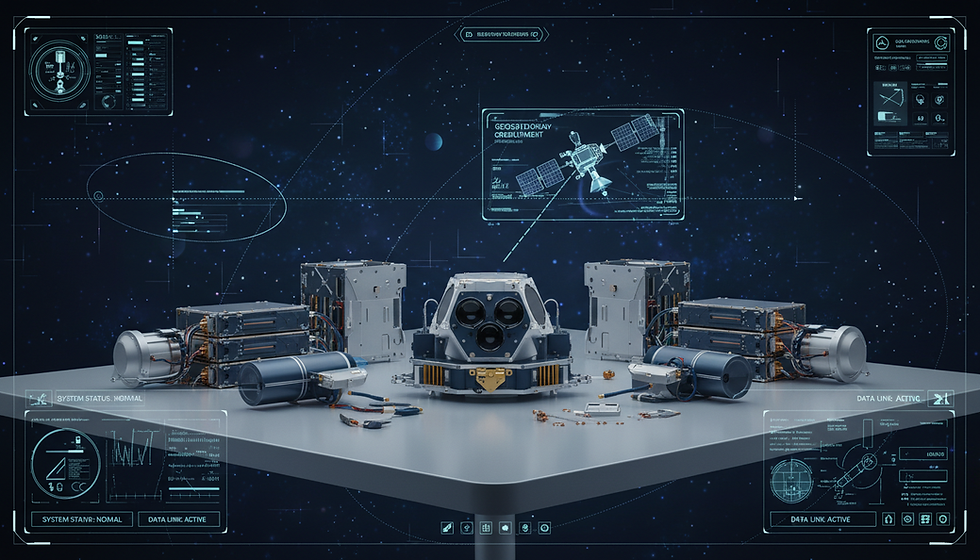
Sensors: Devices such as star trackers, sun sensors, magnetometers, and gyroscopes provide attitude and orbit data.
Actuators: Reaction wheels, magnetorquers, thrusters, or control moment gyroscopes enable attitude adjustments.
Control Algorithms: Software that processes sensor data and commands actuators to maintain or change satellite orientation.
The design process must integrate these components into a cohesive system that meets mission requirements while optimizing for mass, volume, power consumption, and cost.

Key Design Principles for AOCS in Small Satellites
When engineering AOCS for small satellites, several principles guide the design to ensure system robustness and mission success:
1. Modularity and Scalability
A modular design approach allows for flexibility in component selection and system upgrades. For example, a satellite platform may initially use magnetorquers for coarse attitude control and later integrate reaction wheels for fine pointing. This scalability supports a range of mission profiles without redesigning the entire system.
2. Redundancy and Fault Tolerance
Given the harsh space environment, AOCS must incorporate redundancy where feasible. Dual or triple sensor configurations and fail-safe actuator modes help maintain control in case of component failure. Fault detection and isolation algorithms are critical to identify anomalies and switch to backup systems promptly.
3. Power Efficiency
Small satellites have limited power budgets, often relying on solar panels and batteries. AOCS components and control strategies must minimize power consumption. For instance, magnetorquers consume less power than reaction wheels but offer lower precision. Balancing these trade-offs is essential.
4. Precision and Stability
The required pointing accuracy depends on the mission. Earth observation satellites may need arcsecond-level precision, while communication satellites might tolerate lower accuracy. Control algorithms must be designed to achieve the necessary stability without excessive actuator activity, which can drain power and reduce component lifespan.
5. Environmental Considerations
Thermal variations, radiation, and microgravity affect sensor performance and actuator reliability. Materials and components must be selected to withstand these conditions. Additionally, the control system should compensate for environmental disturbances such as atmospheric drag and magnetic field variations.
Sensor and Actuator Selection Strategies
Selecting appropriate sensors and actuators is a critical step in AOCS design. The choice depends on mission objectives, satellite size, and available resources.
Sensors
Star Trackers: Provide high-precision attitude determination by imaging star fields. Suitable for missions requiring fine pointing but often expensive and power-intensive.
Sun Sensors: Offer coarse attitude information by detecting the sun’s position. Low power and cost but limited accuracy.
Magnetometers: Measure the Earth’s magnetic field vector, useful for attitude estimation and control with magnetorquers.
Gyroscopes: Measure angular velocity, essential for inertial navigation and attitude propagation between sensor updates.
Actuators
Reaction Wheels: Provide precise torque for fine attitude control. They consume power continuously and require momentum management to avoid saturation.
Magnetorquers: Generate torque by interacting with Earth’s magnetic field. Power-efficient but limited in control authority and direction.
Thrusters: Used for orbit adjustments and sometimes attitude control. Require propellant and add complexity.
A typical small satellite AOCS might combine magnetometers and sun sensors for attitude determination with magnetorquers for control, supplemented by reaction wheels if higher precision is needed.

Control Algorithms and Software Architecture
The control software is the brain of the AOCS, interpreting sensor data and commanding actuators. The design of control algorithms must consider computational limitations and real-time requirements.
Attitude Determination
Algorithms such as the Extended Kalman Filter (EKF) fuse data from multiple sensors to estimate the satellite’s attitude accurately. The EKF accounts for sensor noise and biases, providing robust state estimation.
Attitude Control
Control laws like Proportional-Integral-Derivative (PID) controllers or more advanced model predictive controllers regulate actuator commands to maintain or change orientation. The choice depends on system dynamics and mission demands.
Momentum Management
For systems with reaction wheels, momentum buildup due to external torques must be managed. Strategies include desaturation maneuvers using magnetorquers or thrusters to unload accumulated momentum.
Software Architecture
A layered software architecture separates hardware drivers, control algorithms, and mission management. This modularity facilitates testing, maintenance, and upgrades.
Testing and Validation of AOCS for Small Satellites
Rigorous testing is essential to verify AOCS performance before launch. Testing strategies include:
Hardware-in-the-Loop (HIL) Simulation: Integrates real hardware components with simulation environments to validate control algorithms under realistic conditions.
Environmental Testing: Thermal vacuum chambers and vibration tables simulate space conditions to assess component durability.
Software Verification: Static code analysis, unit testing, and integration testing ensure software reliability.
Iterative testing and validation reduce risks and improve confidence in system performance.
Future Trends in AOCS for Small Satellites
The evolution of small satellite missions drives continuous innovation in AOCS design. Emerging trends include:
Miniaturization of Components: Advances in MEMS sensors and micro-actuators enable more capable AOCS within smaller form factors.
Artificial Intelligence Integration: Machine learning techniques are being explored for adaptive control and anomaly detection.
Integrated Navigation Systems: Combining GPS, vision-based navigation, and inertial sensors for enhanced autonomy.
Standardized Platforms: Development of common AOCS modules to reduce development time and costs.
These trends align with the goal of building indigenous aerospace technology platforms that support diverse and complex space missions.
Building Robust AOCS for Long-Term Mission Success
Developing effective AOCS solutions for small satellites requires a disciplined engineering approach grounded in sound design principles. By carefully selecting sensors and actuators, implementing robust control algorithms, and conducting thorough testing, we can deliver systems that meet stringent mission requirements within the constraints of small satellite platforms.
For those engaged in preliminary mission studies and technical evaluations, understanding these principles is crucial to making informed decisions that impact mission feasibility and success. The integration of aocs design for small satellites into mission planning ensures that attitude and orbit control challenges are addressed early, reducing risk and optimizing performance.
Through sustained engineering efforts and innovation, we can contribute to the development of reliable, efficient, and scalable AOCS solutions that empower the next generation of space missions.


Comments